
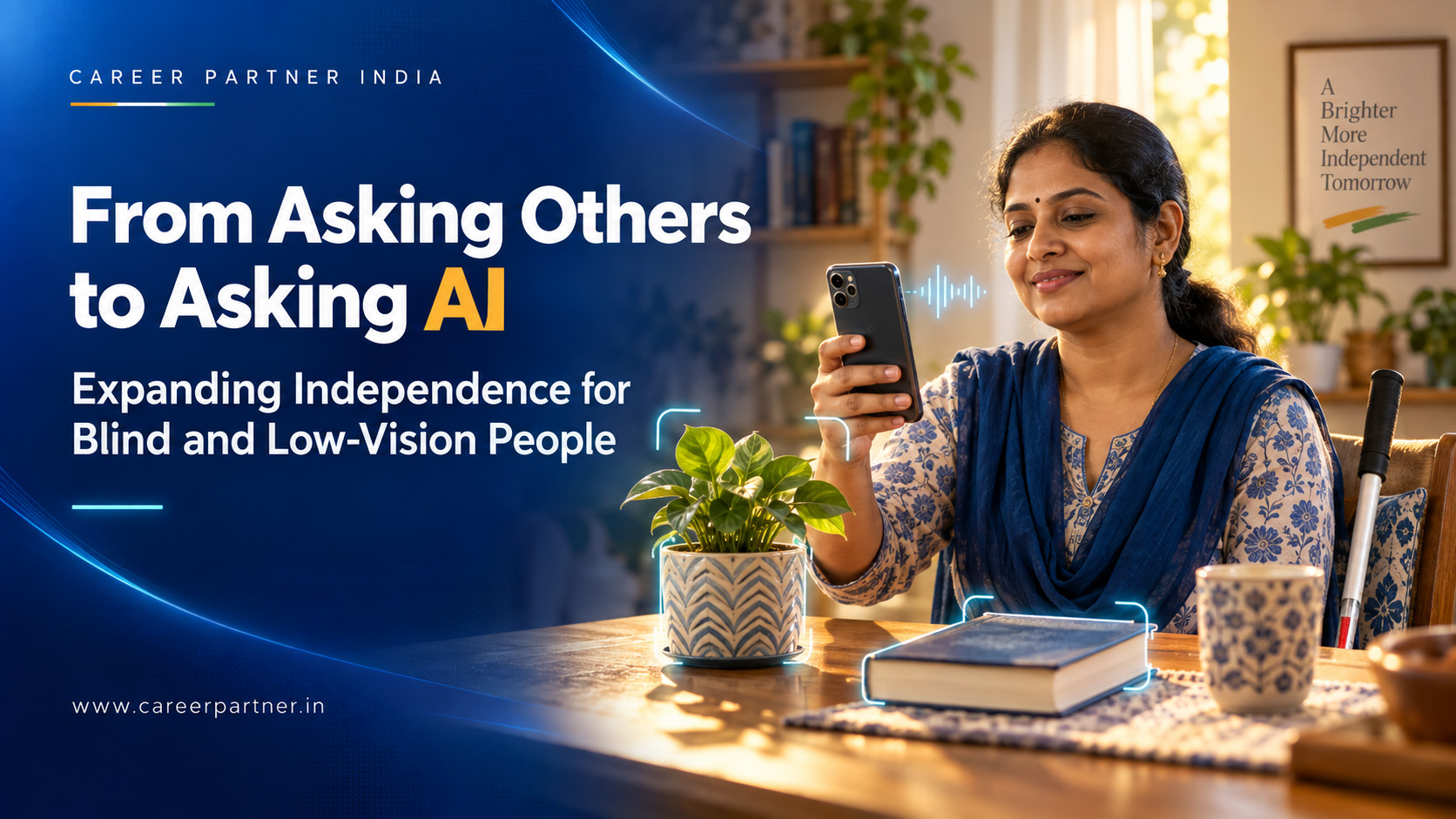
For many sighted people, checking the label on a packet, reading the controls on an appliance, understanding a photograph or scanning a crowded shopping page takes only a few seconds.
For a person who is blind or has low vision, the same task may require accessible labelling, a screen reader, a specialised application or assistance from another person.
Artificial intelligence is beginning to change that relationship—not by giving people sight, and not by making human help unnecessary, but by translating parts of the visual world into conversational information that a person can question and use.
One of the clearest examples is Be My AI, the AI-powered visual assistant within the Be My Eyes platform. A user can take a photograph, receive a detailed description and ask follow-up questions about what the image contains. If the AI cannot answer, if the result needs verification or if the user simply prefers human support, the person can still contact a volunteer through the same service.
This is an important example of what responsible AI can make possible: not replacing human capability, but extending human independence.
A Documented Example: 19 People Reframing Everyday Assistance
A research preprint published on 14 September 2026 interviewed 19 blind and low-vision people about their use of generative AI. The participants described using AI as a communication intermediary: a tool that could translate visual or otherwise inaccessible material into information they could act upon.
The researchers found that some routine requests which had previously gone to family members, friends or other people could instead be directed to AI. Participants reported greater independence and less everyday effort, while also describing concerns about inaccurate answers, disclosure and privacy. Seven participants said they used generative AI several times a day, and all 19 used assistive technologies such as Be My AI or Seeing AI.
This is a real, attributable small-group example—not a claim that every person with visual impairment has the same experience. The study is a preprint, its sample is small, and its interview findings do not prove population-wide effects. Even so, it captures a meaningful shift: AI can change a person’s options for obtaining information, while the person still supplies the purpose, context, judgment and final decision.
The Scale of the Need
The World Health Organization reported in February 2026 that at least 2.2 billion people globally have a near or distance vision impairment. WHO also estimates that vision impairment is associated with approximately US$411 billion in annual global productivity losses.
Medical care, prevention, affordable eyeglasses, cataract surgery and vision rehabilitation remain essential. AI is not a substitute for any of them.
However, many people live with irreversible blindness or low vision, and even people who receive appropriate treatment may continue to encounter environments, products and digital services that were not designed accessibly. Assistive AI can help address part of this everyday information gap.
From Calling a Person to Asking a Visual Assistant
Be My Eyes originally became known for connecting blind and low-vision users with sighted volunteers through live video. The volunteer sees what the user chooses to show through the phone camera and describes it through a two-way audio conversation.
Be My Eyes now combines that human network with AI. According to live figures displayed on the organisation’s website on 20 September 2026, its community included:
- More than 1.1 million blind and low-vision users
- More than 11.1 million volunteers
- Availability in 150+ countries
- Support across 180+ languages
Be My AI adds a different form of assistance. The user takes a picture and receives a detailed description. Because the system is conversational, the person can ask it to look more closely at a particular object, explain part of a scene or answer a more specific question.
That difference matters. Traditional object recognition might identify “a refrigerator” or “several food items.” A conversational visual assistant can potentially identify visible ingredients and then respond to a follow-up question about what meal could be prepared with them.
The value is not only description. It is the ability to continue the inquiry.
What AI Can Help People Do
The most meaningful applications are often ordinary tasks that occur repeatedly throughout the day.
Visual AI may help a blind or low-vision user:
- Read visible text on packaging or household products
- Distinguish between similar objects
- Understand the contents of a photograph
- Describe clothing, colours or visual presentation
- Interpret parts of a website or screen that are not properly accessible
- Summarise a visually crowded shopping page
- Examine an image and ask follow-up questions privately
- Understand what is displayed on an appliance or control panel
These uses can reduce the number of routine occasions on which a person must wait for someone else to become available.
That does not make assistance from family members, friends or volunteers less valuable. It gives the user another option—and the freedom to decide which kind of help is appropriate for each situation.
The Human Capability Has Not Disappeared
It would be misleading to describe the AI as doing everything by itself.
The human user still contributes the most important elements of the process:
- Deciding what information is needed
- Positioning the camera and choosing what to share
- Asking useful follow-up questions
- Interpreting the response in context
- Recognising when the answer seems incomplete or uncertain
- Deciding when human verification is necessary
- Taking responsibility for the final action
The AI contributes speed, availability, conversational visual interpretation and the ability to analyse a picture without requiring another person to join every routine interaction.
The result is best understood as human capability plus AI assistance, not human capability replaced by AI.
Independence Includes the Freedom to Ask Privately
There is another dimension that is easy for sighted people to overlook: privacy.
Asking another person to read a personal letter, describe a private photograph or identify an item can require revealing information that someone may prefer to keep to themselves. An AI assistant can sometimes reduce that social and privacy burden.
The September 2026 study described above shows why this matters. AI changes not only how information is accessed, but also who a person must ask, what must be disclosed and how much control the person retains over an everyday task.
AI and Human Volunteers Are Stronger Together
The Be My Eyes model is valuable because it does not force a false choice between AI and people.
Be My AI can respond immediately to many low-risk visual questions. If the answer is doubtful, incomplete or unsuitable, the user can reach a human volunteer.
This creates a practical sequence:
- Use AI for speed, availability and routine interpretation.
- Question the response conversationally.
- Escalate to a person when judgment, verification or human understanding is needed.
That is a better model for many areas of AI adoption. Machines can handle frequent, repeatable or time-sensitive information tasks, while people remain available for ambiguity, accountability, empathy and higher-stakes judgment.
The future of useful AI may therefore be neither “AI instead of humans” nor “humans without AI.” It may be intelligently designed cooperation between the two.
The Limitations Are Not a Footnote
Visual AI can be wrong. It may overlook an object, misread text, misunderstand context or produce a confident description that does not match reality.
For a sighted user, some errors may be immediately visible. For a blind user, independently checking a visual answer may be much harder. That makes honest communication of uncertainty especially important.
Be My Eyes’ terms explicitly state that Be My AI can make mistakes and “hallucinate.” The service must not be relied upon:
- To cross a street
- As a replacement for a white cane, guide dog or other mobility aid
- For emergencies
- To identify medication or determine dosage
- To check for ingredients that could cause an allergic reaction
- As the sole source for any decision that could cause harm
These restrictions do not cancel the technology’s value. They define where the technology is currently appropriate.
Responsible use means matching the tool to the consequence of being wrong. Describing a non-critical photograph is different from reading a prescription. Choosing between two shirts is different from crossing a busy road.
The higher the potential harm, the stronger the need for human verification, specialised equipment or qualified professional assistance.
Privacy Must Be Understood, Not Assumed
Camera-based AI necessarily processes images of the user’s environment. Those images may contain faces, addresses, financial details, medicines, documents or other sensitive information.
Be My Eyes’ privacy policy, effective 1 September 2026, says that Be My AI photographs and queries are processed to provide the service, and that its AI provider is not permitted to use those submissions to train AI models. The policy also says Be My Eyes may use and analyse submissions and responses to improve its services other than by training AI models, enforce its terms, promote safety and develop products.
The same policy advises users not to expose identifying documents, financial information, home addresses, passwords, health information or other sensitive personal data.
This is a broader lesson for every AI user: convenience should never replace informed consent. Before sharing an image, document or conversation with any AI system, people should understand what is collected, where it is processed, how long it may be retained, who may receive it and what controls are available.
What This Means for Careers and Work
Accessibility is not only about completing household tasks. It also affects education, employment and professional participation.
Inaccessible screenshots, visual dashboards, scanned documents, presentation graphics and poorly labelled interfaces can create barriers even when a person is fully qualified to perform the underlying work.
Conversational visual AI may help a worker obtain an initial description of an image, interpret part of a screen or ask questions about visual material. Be My Eyes also describes desktop work tools that can analyse information from screens, clipboards and cameras for blind and low-vision workers.
But employers must not use AI as an excuse to stop building accessible systems. Websites, documents, software and workplace processes should still follow proper accessibility standards. AI assistance should expand choice and capability—not transfer the entire burden of inaccessible design onto the disabled employee.
A Lesson for Policymakers and Technology Leaders
The policy discussion around AI frequently focuses on productivity, competition, job displacement and national advantage. These questions matter, but they are incomplete.
Leaders should also ask:
- Can AI give people more control over ordinary daily tasks?
- Can it reduce barriers to education and employment?
- Are disabled people involved in designing and testing the systems intended for them?
- Does the system communicate uncertainty in an accessible way?
- Is human assistance available when AI reaches its limits?
- Are privacy protections understandable and meaningful?
- Is access affordable across countries, languages and income levels?
Be My Eyes’ development process included feedback from blind and low-vision beta testers, and the organisation retained access to volunteers alongside AI. Those choices point toward a valuable principle: assistive technology should be built with the people who will use it, not merely for them.
Policymakers should support innovation while requiring meaningful safety, privacy, accessibility and accountability. Overly broad restrictions could delay tools that materially improve independence. Uncritical deployment could expose users to preventable harm. The better path is responsible access shaped by the lived experience of the affected community.
AI as Leverage for Human Independence
The deepest value of AI is not that it can produce more content or automate more office work. Its value becomes clearest when it gives someone greater agency over a part of life that previously required waiting, disclosing or depending on another person.
Visual AI does not eliminate blindness. It does not correct inaccessible design, replace medical care or make human support unnecessary. It can make selected visual information available in a new form—quickly, conversationally and, in many cases, independently.
That is human advancement in a meaningful sense.
The strongest future will not be one in which people are told to step aside for artificial intelligence. It will be one in which AI is designed to help more people participate, decide, learn, work and live with greater independence—while human judgment, dignity and responsibility remain central.
Sources
- World Health Organization, “Blindness and vision impairment”, updated 10 February 2026.
- Be My Eyes, homepage and current community statistics, accessed 20 September 2026.
- Be My Eyes, “Introducing: Be My AI”, 7 August 2023.
- OpenAI, “Be My Eyes: Transforming visual accessibility”.
- Be My Eyes, Terms of Service, effective February/March 2026.
- Be My Eyes, Privacy Policy, effective 1 September 2026.
- Protik Dey, Mohd Saifuzzaman and Taslima Akter, “More Than Just Access: Generative AI as Communication Intermediary for Blind and Low-Vision Users”, research preprint, 14 September 2026.
- Rahaf Alharbi, Pa Lor, Jaylin Herskovitz, Sarita Schoenebeck and Robin Brewer, “Misfitting With AI: How Blind People Verify and Contest AI Errors”, research preprint.
Accuracy and Editorial Note
This article was researched using publicly available information from the World Health Organization, Be My Eyes, OpenAI and published research sources. Platform figures are live values displayed by Be My Eyes when accessed on 20 September 2026 and may change over time.
The article distinguishes product claims, research findings and editorial interpretation. The September 2026 study cited above is a research preprint based on 19 participants and should not be treated as representative of every blind or low-vision person. AI systems, product terms, privacy practices and availability can change. Readers should review the latest official information before relying on any service.
Every effort has been made to verify the facts and present the subject responsibly. If you identify an error or important update, please contact Career Partner India so the article can be reviewed and corrected.
Shakti Saran
Founder, Career Partner India
www.careerpartner.in