
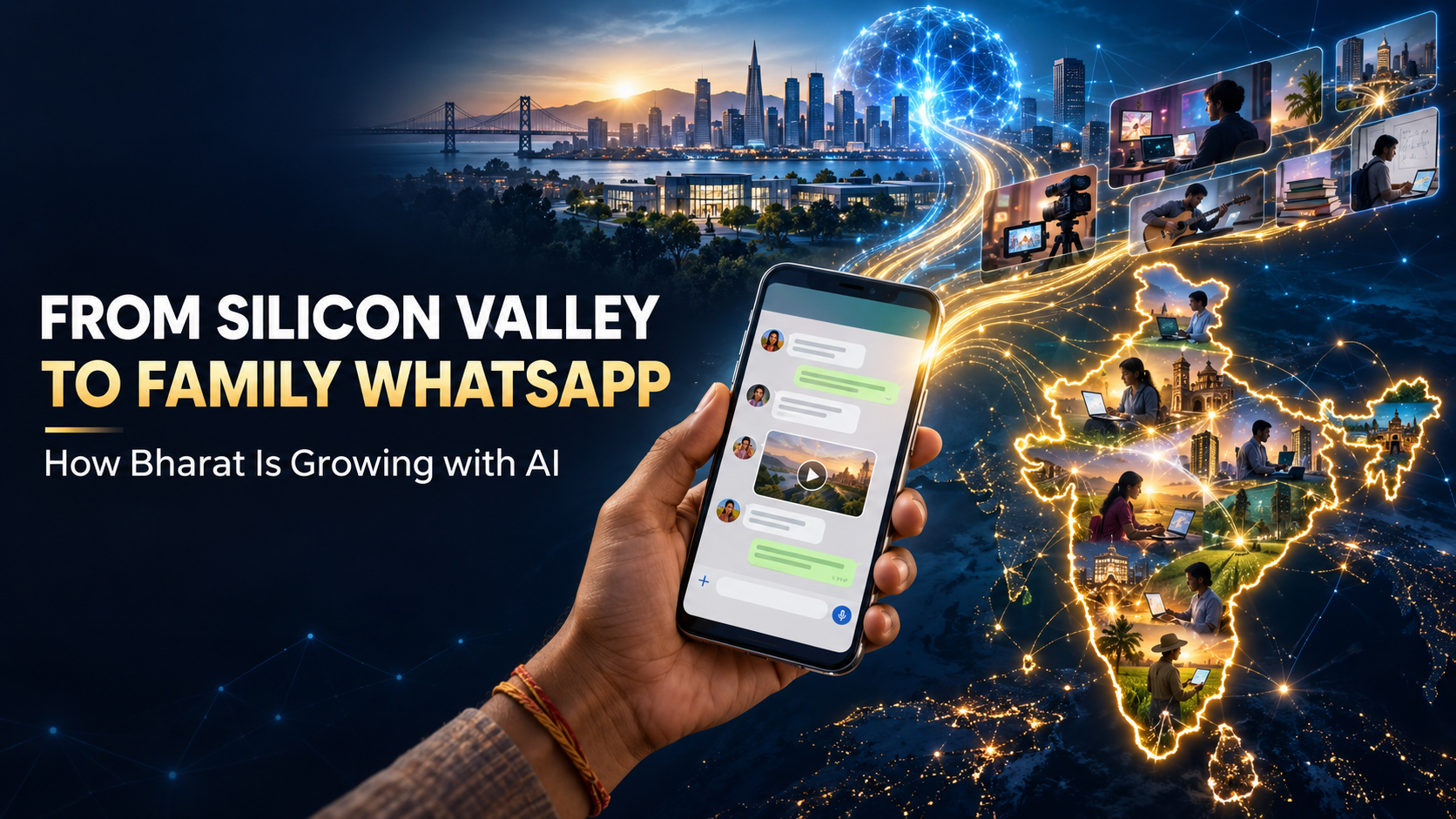
Global Indians, home-grown creators, entrepreneurs and public institutions are bringing frontier AI knowledge and opportunities closer to millions of people.
A few days after OpenAI introduced GPT-6 Astra, my maternal uncle—who lives in the United States—shared a video about it in our family WhatsApp group.
The video, created by a young Indian educator, discussed how rapidly artificial intelligence is transforming work and what people can do to remain relevant. My uncle added that AI is already among us and that anyone who wants to participate in the workforce of the future must understand how jobs and work are changing.
That small family exchange made me think.
One of the world’s newest AI developments had travelled from an American laboratory to an Indian creator, then through an Indian living in the United States, and finally into a family conversation in Bharat (India).
This is how knowledge now travels—not only through universities, companies and conferences, but also through creators, communities and family WhatsApp groups.
More importantly, the conversation reflects something much larger: ChatGPT is no longer a distant technology understood by only a small group of engineers. It is becoming a practical companion for millions of people across Bharat who want to learn, work, create, solve problems and move forward.
More Than 100 Million Weekly Users in India
In February 2026, OpenAI reported that India had more than 100 million weekly ChatGPT users, including students, teachers, developers and entrepreneurs.
That number is striking, but the real story is not merely how many people are using ChatGPT. It is what they can now attempt because such a tool is available to them.
A student who cannot afford several private tutors can ask for a difficult idea to be explained step by step.
A job seeker can improve a résumé, practise an interview and understand the skills required for a particular role.
A shopkeeper or small-business owner can prepare a product description, customer message, advertisement or business plan.
A programmer can examine an unfamiliar error, learn a new framework and turn an idea into a working prototype.
A professional who is hesitant about writing in English can organise thoughts, improve clarity and communicate with greater confidence.
A creator can move from a rough idea to a script, graphic concept, video plan or publishing calendar.
None of these abilities began with ChatGPT. The intelligence, ambition and lived experience belong to the person. What ChatGPT can provide is leverage: it can help someone learn faster, explore further and convert an intention into action with fewer barriers.
A Patient Learning Companion
Education may be one of ChatGPT’s most meaningful contributions to Bharat.
Students do not all begin from the same place. Some attend well-resourced institutions and have access to experienced teachers, mentors and coaching. Others may be studying in a small town, learning in a second or third language, sharing devices or trying to master a subject without personal guidance.
ChatGPT cannot remove every inequality, but it can place a remarkably patient learning companion in the hands of anyone with access to it.
A learner can ask the same question repeatedly without embarrassment. The explanation can be simplified, expanded, translated, illustrated through an analogy or converted into a quiz. Instead of merely receiving an answer, the student can ask ChatGPT to teach the underlying concept, test understanding and identify gaps in reasoning.
Indian college students have reported using ChatGPT to explain difficult concepts, build study plans, create practice quizzes, evaluate assignments, summarise notes and prepare presentations.
OpenAI has also announced education partnerships in India and plans involving approximately half a million ChatGPT licences and training opportunities for students and educators. These initiatives include teachers in government schools, technical institutes under AICTE and participating schools across the country.
The most valuable use of AI in education is not to avoid thinking. It is to make deeper thinking more accessible.
If students use ChatGPT merely to copy an assignment, they may submit more words while learning less. If they use it to challenge their assumptions, request examples, test their knowledge and receive constructive feedback, it can become a powerful intellectual gymnasium.
Giving Small Businesses Access to Bigger Capabilities
Bharat’s economy is powered not only by large corporations but also by countless entrepreneurs, professionals, family businesses, independent creators and small teams.
Many of them have excellent products, services and ideas but limited access to specialist support. A small enterprise may not have separate teams for research, marketing, content, design, data analysis, customer communication and technology.
ChatGPT can help narrow that capability gap.
It can assist a founder in comparing business ideas, studying customer needs, organising operations or preparing the first version of a proposal.
It can help a local business write clearer website content, reply professionally to an international enquiry or translate information for a different audience.
It can help a team examine a spreadsheet, structure a campaign or document a process that previously existed only in someone’s memory.
This does not mean that one AI tool magically turns every business into a success. Markets still have to be understood. Customers still have to be served. Products must still be good, promises must be fulfilled and decisions must remain accountable to people.
But when a small team can perform some tasks that once required a much larger team, more Indians can experiment, compete and grow.
Confidence Can Be as Important as Productivity
One of ChatGPT’s quieter contributions is confidence.
Many capable people know what they want to say but are unsure how to present it. Some worry about grammar. Some have never written a formal proposal, professional email or public article. Others possess deep expertise in their own field but find digital tools intimidating.
ChatGPT can help them begin.
It can turn scattered thoughts into a structure, explain unfamiliar terminology and provide a first draft that the user can question and improve. It can converse without making someone feel judged for asking a basic question.
This matters enormously in a country with hundreds of languages and wide differences in educational and professional exposure. As support for Indian languages improves, more people can interact with advanced technology through the language in which they think most naturally.
The result is not only greater efficiency. It is a greater willingness to participate.
Someone who previously thought, “I do not know how to do this,” may now think, “Let me understand it and try.”
That change in mindset can open doors.
From Fear of AI to the Ability to Work With AI
Every major technological transition creates anxiety, and the concern surrounding jobs is legitimate.
AI will change tasks. Some kinds of work will shrink, others will be redesigned, and entirely new roles will emerge. Simply telling people not to worry would be neither honest nor helpful.
The better response is preparation.
People who learn to work effectively with AI may be able to research faster, communicate better, analyse more information and take on responsibilities that were previously beyond their time or resources.
A designer can explore more concepts.
A teacher can prepare more personalised material.
A marketer can study more customer perspectives.
A developer can prototype faster.
A manager can compare alternatives before making a decision.
The winning skill will not be typing a clever prompt once. It will be combining domain knowledge, curiosity, critical thinking and ethical judgment with AI’s speed and breadth.
ChatGPT can produce a confident answer that is incomplete or wrong. It does not personally bear the consequences of a business, medical, legal or financial decision. People must verify important facts, protect sensitive information, consult qualified professionals where necessary and remain responsible for the final outcome.
The future therefore belongs neither to humans working exactly as before nor to AI operating without human direction. It belongs to people who learn how to collaborate intelligently with AI while retaining judgment, empathy, accountability and purpose.
Growth Beyond the Workplace
Not all progress appears in a salary slip or company report.
People use ChatGPT to plan their day, understand an unfamiliar process, prepare questions for a doctor, explore a new subject, organise family travel, improve communication or think through a difficult decision.
It can help an elderly person understand unfamiliar digital language or help a parent create a learning activity for a child.
A large-scale study of consumer ChatGPT usage found that practical guidance, information-seeking and writing together accounted for around three-quarters of conversations. The study estimated that approximately 30% of consumer usage was work-related and 70% took place outside work—showing how AI can create value in both professional and everyday life.
This everyday assistance is important in Bharat, where access to specialised guidance can vary greatly by location, income, language and social network.
AI does not replace family, community or human expertise. But it can give a person a useful starting point at the exact moment help is needed.
Bharat Must Progress From Using AI to Building With AI
Widespread ChatGPT adoption is encouraging, but becoming a global AI leader will require more than becoming one of the world’s largest user bases.
Bharat must also build.
We need researchers advancing the science, engineers creating reliable systems, educators teaching responsible use, entrepreneurs solving Indian problems and institutions expanding access to computing and high-quality data.
We need AI that understands India’s languages, cultural contexts and development priorities. We need safeguards that protect privacy, security and human dignity.
India is already investing in shared computing infrastructure, indigenous foundation models, datasets, skills and responsible-AI initiatives through the IndiaAI Mission.
These efforts can help ensure that Indians are not merely consumers at the edge of someone else’s technological ecosystem, but creators shaping what AI becomes.
ChatGPT can play an important role in that journey. It lowers the distance between curiosity and capability. It allows more people to learn what was once difficult to access, attempt what once appeared too complicated and bring their own ideas into the digital world.
From a Family Message to a National Possibility
The video my uncle shared was about preparing for a changing world of work. Yet the way it reached me carried another message.
Indians across the world are watching, learning and sharing.
Indian creators are translating complex technological developments into accessible conversations.
Students are discovering new ways to learn.
Professionals are strengthening their abilities.
Entrepreneurs are gaining access to capabilities that once belonged mainly to large organisations.
Public institutions and private companies are building infrastructure for the next stage.
From Silicon Valley to a family WhatsApp group, AI knowledge is moving quickly—and Bharat is not standing still.
The most hopeful possibility is not that ChatGPT will do everything for us. It is that millions of people will use it to do more for themselves, their families, their organisations and their country.
ChatGPT has already placed a powerful new instrument in millions of Indian hands.
What Bharat learns, creates and accomplishes with it will be the far more important story.
Sources
- Introducing OpenAI for India — OpenAI
- Introducing the OpenAI Learning Accelerator in India — OpenAI
- Top Chats From College Students in India — ChatGPT for Education
- How People Are Using ChatGPT — OpenAI
- IndiaAI Mission Initiatives — Press Information Bureau, Government of India
Accuracy and Editorial Note
Career Partner India makes every reasonable effort to research and verify the information presented in our articles using official, reputable and publicly available sources.
One of our aims is to help readers understand how studying and/or working in developed countries can provide valuable knowledge, international exposure, professional experience and opportunities that may contribute to greater career success and meaningful contributions to India.
Despite our sincere efforts, an article may occasionally contain an unintended error or outdated information. We sincerely apologize for any such inaccuracies and would be happy to review and update the article with the correct details.
To report a correction or share verified information, please contact our founder Mr. Shakti Saran: Email / LinkedIn