
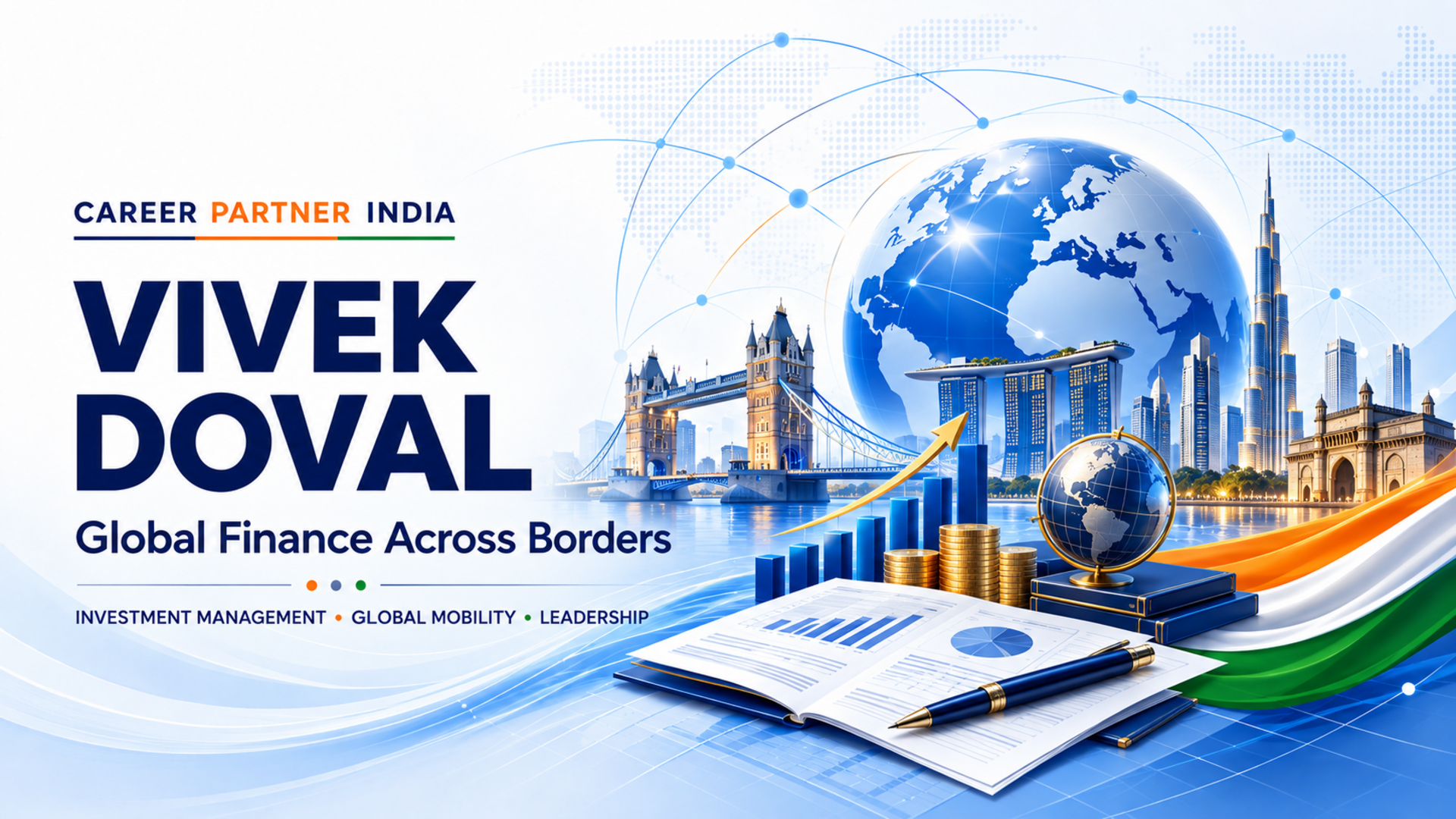
From Indian roots to the financial centers of the United Kingdom, Singapore and the UAE, Vivek Doval’s professional journey demonstrates how qualifications, experience and global access can work together.
Success in global finance rarely comes from a single qualification, employer or country. It is usually built through a combination of specialised knowledge, experience inside major institutions, exposure to different markets, professional relationships and the ability to move wherever the strongest opportunities emerge.
The career of Vivek Doval offers an interesting example of this international path.
Vivek Doval is the younger son of Ajit Doval, India’s National Security Adviser. However, his own professional identity has developed in a very different field: investment management and global finance. Publicly available professional and institutional material associates him with the London School of Economics, Harvard Business School, the CFA and CAIA professional designations, Credit Suisse, British Airways Pension Investment Management, the GNY Asia Fund and senior investment roles in the United Arab Emirates.
His journey is also relevant to Career Partner India because it spans institutions and investment activity connected with the United Kingdom, Singapore and the UAE. During sworn testimony in a Delhi court in May 2019, Doval described himself as: “I am a UK citizen and I am a very proud overseas citizen of India.” His career therefore illustrates not only how a person of Indian origin can build an international career, but also how global mobility and access to different financial centers can expand the opportunities available along the way.
Building Professional Credibility Through Education and Qualifications
Fund management is a field in which judgement ultimately matters more than the number of certificates displayed after a person’s name. Nevertheless, rigorous education and respected professional qualifications can help establish the technical foundation and initial credibility required to enter the industry.
In July 2025, the Department of Management Studies at IIT Roorkee introduced Vivek Doval as an alumnus of the London School of Economics and Harvard Business School, as well as a CFA and CAIA charterholder. The same introduction described him as having more than two decades of international experience in finance and investments.
These qualifications represent different but complementary parts of an investment professional’s development:
- University education can build a foundation in economics, finance, institutions and analytical reasoning.
- The Chartered Financial Analyst programme is internationally recognised for its focus on investment analysis, portfolio management, ethics and professional standards.
- The Chartered Alternative Investment Analyst qualification focuses on alternative assets and investment strategies beyond conventional listed equities and bonds.
- Executive education and exposure to leading business schools can broaden a professional’s understanding of organisations, leadership and global decision-making.
Qualifications do not guarantee investment success. Markets repeatedly challenge even the most educated professionals. Their value lies in developing the language, analytical discipline and ethical framework with which increasingly complex decisions can be approached.
Learning Inside Major Financial Institutions
Public professional material has associated Doval’s earlier career with Credit Suisse and British Airways Pension Investment Management.
Experience inside such institutions can be an important form of professional apprenticeship. A large bank exposes a finance professional to formal research processes, sophisticated clients, risk controls and markets operating across jurisdictions. A major pension investment organisation introduces a different responsibility: managing capital with long-term obligations to thousands of members and beneficiaries.
This distinction matters. Managing institutional money is not simply about identifying an asset that might rise in value. It requires an understanding of portfolio construction, liquidity, risk, governance, accountability and the relationship between present decisions and future liabilities.
For students and young professionals, the broader lesson is that early institutional experience can create capabilities that are difficult to acquire through theory alone. It teaches how decisions are documented, questioned, approved and monitored when real capital and real responsibilities are involved.
Moving From Institutions to Fund Management
Doval later moved from established institutions towards entrepreneurial fund management.
Contemporary business reporting from 2016 described GNY Asia Fund as a Singapore-based investment initiative designed to take both long and short positions in Asian equities. IIT Roorkee’s 2025 introduction described Vivek Doval as a co-founder and chief investment officer of GNY Asia Fund.
The geographical structure of an international fund can involve several jurisdictions. Its investment professionals, advisers and service providers may operate in different financial centers, while the portfolio itself may invest across a much wider region.
Moving from employment within a large institution to helping lead a fund represents a significant professional transition. An institutional employee works within an established system. A fund leader must help construct the system: defining an investment philosophy, developing research and risk processes, communicating with investors, coordinating service providers and remaining accountable for performance.
The transition requires more than market knowledge. It demands leadership, patience, communication, governance and the ability to make decisions under uncertainty.
Why British Citizenship Is Professionally Relevant
OpIndia’s account of Doval’s sworn testimony provides direct, attributed support for his UK citizenship. Alongside knowledge and experience, this legal access to an important financial center can materially influence a professional’s career. According to the UK government, every British citizen automatically has the right of abode in the United Kingdom and can live and work there without immigration restrictions.
For Doval—or any international finance professional with that status—this freedom can be extremely valuable.
It can provide:
- unrestricted access to employment opportunities in the United Kingdom;
- the ability to change employers without making immigration status dependent on a new sponsor;
- freedom to establish or participate in businesses without relying on a work visa;
- long-term residential stability while professional relationships and credibility are built;
- proximity to London’s banks, asset managers, pension funds, advisers and international investors; and
- a more secure base for a career involving frequent cross-border travel and business activity.
The professional logic is easy to understand. A highly qualified finance professional with unrestricted access to one of the world’s leading financial centers operates within a wider opportunity set than an otherwise comparable professional whose ability to remain employed there depends on continuing visa sponsorship.
It would nevertheless be speculation to say why Doval became a UK citizen. The public sources reviewed for this article do not establish his personal motivation or the date on which he acquired citizenship. Nor do they prove that citizenship caused his professional success. What can responsibly be said is that British citizenship provides substantial practical advantages for building a career in the United Kingdom, and that Doval’s qualifications, institutional experience and investment judgement remained essential to making use of those advantages.
Legal access is also country-specific. A right to work in one country does not automatically provide the same right elsewhere. Professional competence, employer requirements and local immigration systems continue to matter whenever a career crosses borders.
That distinction is valuable for young readers: privilege and achievement can coexist. Recognising an enabling advantage does not erase the knowledge and work required to use it effectively.
Singapore: A Strategic Asian Financial Center
Singapore represented a logical location for an investment professional focused on Asian markets. It combines a stable regulatory environment with access to investors, financial institutions and businesses across Southeast Asia and the wider Asia-Pacific region.
For a fund investing in Asian equities, operating from Singapore can offer more than geographical convenience. It places an investment team closer to regional information flows, corporate activity, market participants and the economic changes shaping Asia.
It can also expand professional perspective. Experience connected with London-based institutions and a Singapore-based fund brings exposure to two distinct but interconnected financial ecosystems: one rooted in a long-established European and global capital market, and another positioned at the center of Asia’s economic growth.
This is where the value of being global becomes deeper than simply collecting countries on a résumé. Each market teaches a professional to examine risk, regulation, business culture and investor behaviour through a different lens.
A More Recent Chapter in the UAE
Doval’s more recent publicly visible professional material places him in the United Arab Emirates.
IIT Roorkee’s 2025 introduction identified him as a managing director associated with RG Group LLC and First Abu Dhabi Bank. More recent material shared by Torch Investment Lab in September 2026 describes him as Managing Director, Royal Group, UAE.
The UAE has become an increasingly important bridge connecting capital and opportunities across Asia, Europe, Africa and the Middle East. For an investment professional with experience in London-linked institutions and Asian fund management, the country represents another strategic vantage point from which to understand global capital flows.
Rather than presenting Doval only as someone who once ran a hedge fund, it is more accurate to see his career as an evolving journey across institutional investing, fund management and senior investment leadership in several major financial centers.
Remaining Connected to India
An international career does not necessarily weaken a professional’s connection with India. In Doval’s case, recent public discussions show continuing engagement with India’s economic and investment potential.
In conversations published by Torch Investment Lab, he has discussed the breadth and depth of India’s listed equity market, the growing influence of systematic investment plans and the ways artificial intelligence may spread through the Indian economy.
One of his central observations is that investors should look beyond companies explicitly labelled as “AI companies.” Businesses across banking, technology services and other industries may benefit by using artificial intelligence to improve productivity, reduce costs or serve customers more effectively.
This reflects the perspective of a global investor looking at India both from within its economic story and from outside it. International experience can make it easier to compare India with other markets, understand how global capital evaluates the country and identify the areas in which India possesses unusual scale or depth.
This is one of the most meaningful contributions that globally experienced professionals of Indian origin can make. They can connect Indian opportunities with international capital, standards, networks and ideas while carrying an understanding of India into decision-making rooms elsewhere in the world.
What Aspiring Finance Professionals Can Learn
Vivek Doval’s journey offers several career lessons without suggesting that every student must reproduce the same path.
1. Build depth before seeking visibility
Finance rewards analytical discipline. Economics, accounting, valuation, statistics, portfolio construction and risk management create a stronger foundation than commentary without technical depth.
2. Use qualifications as foundations, not decorations
Credentials such as the CFA or CAIA can open doors and impose a disciplined learning structure. Their real value appears when knowledge is applied to uncertain decisions involving actual capital.
3. Learn how institutions operate
Experience within established financial organisations can teach standards of research, governance and accountability that later become invaluable in leadership or entrepreneurship.
4. Understand that geography affects opportunity
London, Singapore and the UAE offer different combinations of capital, talent, regulation and regional access. A willingness to move can expose a professional to opportunities that may not exist in one location alone.
5. Treat immigration status as part of career planning
Students frequently plan qualifications and job applications while treating visas, residency and citizenship as secondary administrative matters. In reality, legal access to a labour market can determine which opportunities are realistically available and how much professional freedom a person possesses.
No citizenship guarantees success. However, the right to live and work in an important market can provide continuity, reduce dependence on individual employers and make long-term career-building easier.
6. Preserve connections with India while becoming global
Going abroad need not mean moving away from India professionally. International expertise can eventually be directed towards Indian companies, markets, entrepreneurs and investors. A global career can expand the ways in which a person participates in India’s growth.
Talent Matters, but Access Matters Too
Career stories are often simplified into inspirational formulas: study hard, work hard and success will follow. Effort and ability matter enormously, but they do not operate in a vacuum.
A more realistic career equation includes:
*Knowledge + experience + judgement + networks + geography + legal access + opportunity*
Vivek Doval’s career brings many of these elements together. His academic and professional credentials helped establish technical credibility. Major institutions offered experience. Fund management required entrepreneurial responsibility. His work connected with the United Kingdom, Singapore and the UAE provided exposure to different financial ecosystems.
None of these elements should be viewed in isolation. Citizenship without competence does not create an accomplished investment professional. At the same time, competence can travel further when legal and geographical barriers are lower.
That is the larger lesson for Career Partner India’s readers. Becoming global is not about rejecting one’s origins. It is about expanding the range of places, institutions and ideas through which one can learn, contribute and lead.
Vivek Doval’s journey demonstrates how a professional of Indian origin can build a career across countries while continuing to engage with India’s economic future. It is a story not merely of working abroad, but of developing the ability to understand and connect multiple financial worlds.
A Personal Postscript: When Ideas Echo Back
Just a few hours after publishing this article—centred on global education, international experience and professional opportunities in the United Kingdom—I watched an episode of Numb3rs in which Charlie Eppes receives an invitation to teach at the University of Cambridge for a term. Amita responds with delight: “We’re going to England!”
The timing was remarkable. An idea that had occupied my thoughts while developing this article suddenly appeared again through an entirely different medium, almost like an unexpected echo of its central message: pursue the finest education and experience available to you, even when the opportunity takes you across borders.
Similar and sometimes even more remarkable coincidences have occurred in my life for many years, including through several amazing television shows. At unexpectedly relevant moments, a scene, conversation or storyline has reflected an idea, question or project that had recently been occupying my mind.
I do not consider such moments proof that one event caused the other. Their value lies in the meaning they can create. They encourage us to remain attentive, recognise connections and reflect on ideas that might otherwise pass unnoticed.
This particular scene felt like a wonderfully timed reminder of the article’s larger message: becoming global does not require us to leave our roots behind. It can mean expanding our knowledge, experience and perspective—and then carrying everything we learn into the lives and places to which we remain connected.

Screenshot from Numb3rs, Season 6, Episode 15, “Growin’ Up,” included in connection with the personal commentary above. All rights belong to their respective owners.
Article-Specific Accuracy Note
This article is based on publicly available information, including professional posts, institutional introductions, official government guidance, business reporting and a report of Vivek Doval’s sworn court testimony. His UK citizenship is stated in his own words as reported by OpIndia. The article does not claim why or when he acquired it. Career descriptions can change over time. GNY Asia represents an earlier documented stage of his career, while recent professional material identifies him with the UAE. References to Singapore concern the documented base of GNY Asia and do not assert that Doval is presently resident there.
Sources and Further Reading
– Department of Management Studies, IIT Roorkee: Guest lecture introduction for Vivek Doval
– OpIndia: Report of Vivek Doval’s sworn testimony concerning his citizenship
– UK Government: Right of abode in the United Kingdom
https://www.gov.uk/right-of-abode
– UK Government: Proving the right to work
https://www.gov.uk/prove-right-to-work
– The Business Times: GNY Asia Fund launch and investment approach
– Torch Investment Lab: Discussion of AI-related investment opportunities in India
– Vivek Doval: Commentary on India’s capital-market depth
General Disclaimer
This article is intended for educational and career-awareness purposes. It does not constitute investment, financial, legal, immigration or professional advice. Readers should independently verify current professional, regulatory and immigration information before making decisions.
Accuracy and Editorial Note
Career Partner India makes every reasonable effort to research and verify the information presented in our articles using official, reputable and publicly available sources.
One of our aims is to help readers understand how studying and/or working in developed countries can provide valuable knowledge, international exposure, professional experience and opportunities that may contribute to greater career success and meaningful contributions to India.
Despite our sincere efforts, an article may occasionally contain an unintended error or outdated information. We sincerely apologize for any such inaccuracies and would be happy to review and update the article with the correct details.
To report a correction or share verified information, please contact our founder Mr. Shakti Saran: Email / LinkedIn