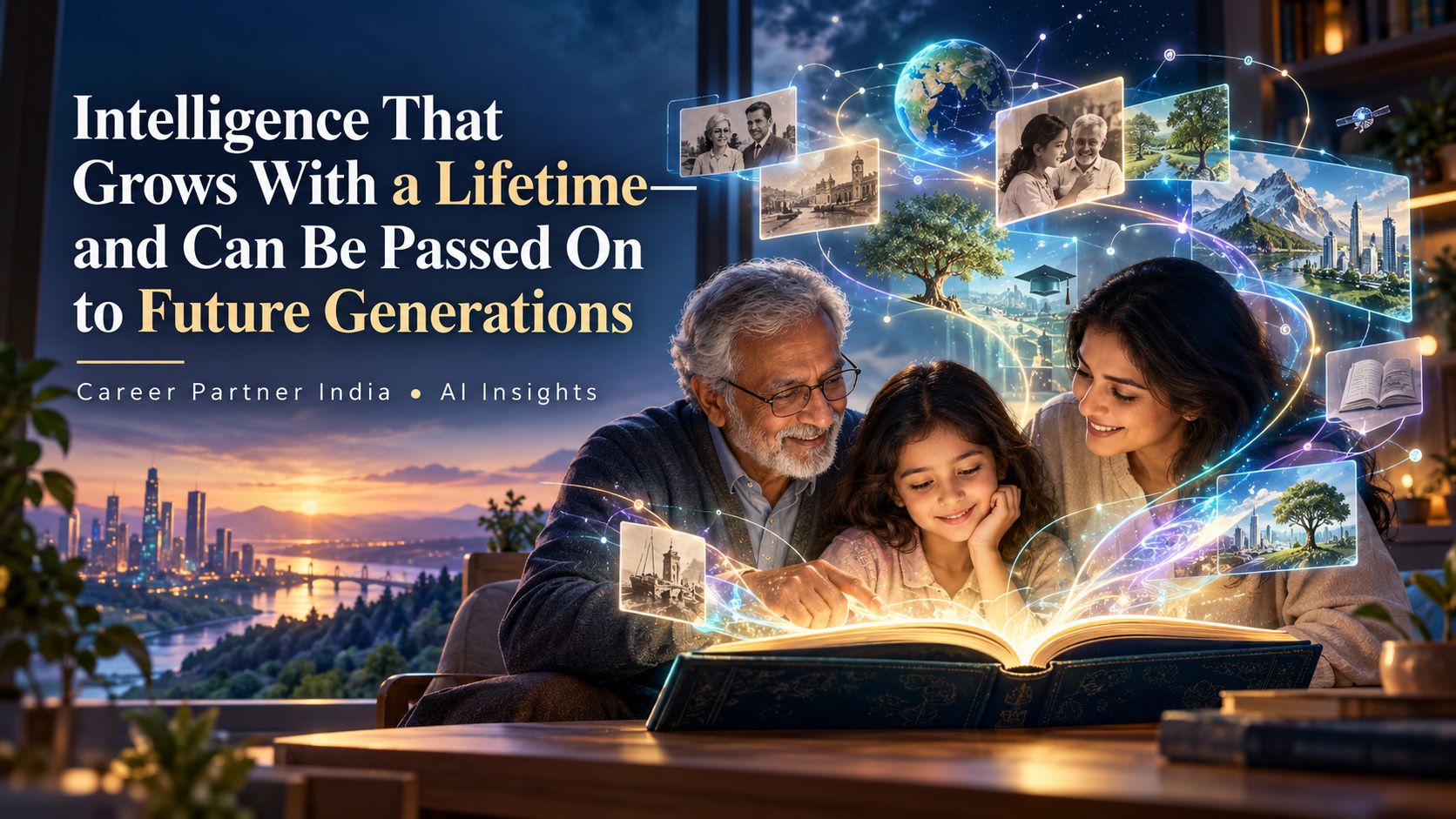
Imagine growing up with an AI companion that helps you learn, remembers what matters, connects experiences across decades, and enables future generations to benefit from the knowledge you’ve accumulated throughout your life.
What If AI Had Been With Us for Decades?
Think about everything you have learned, experienced, created, discussed, and discovered throughout your life.
The books you read. The people you met. The ideas that came to you unexpectedly. The mistakes that taught you valuable lessons. The opportunities you recognized—and those you missed.
How much of that information can you still remember?
And how much of it exists somewhere in old notebooks, photographs, emails, documents, conversations, or digital archives that you may never revisit?
Now imagine having an intelligent companion throughout those years.
Not simply a chatbot that answers questions, but an AI system capable of helping you preserve knowledge, retrieve forgotten information, recognize connections, and develop your ideas over time.
What might you accomplish if decades of accumulated knowledge remained accessible and useful to you?
And what if the knowledge you developed could eventually benefit your children, grandchildren, students, colleagues, or future researchers?
This could become one of the most meaningful long-term applications of artificial intelligence.
From Artificial Intelligence to Lifelong Intelligence
Much of today’s discussion about AI focuses on immediate productivity.
AI can help people write, analyze, research, program, translate, learn, and solve problems.
These capabilities are already changing how students study, professionals work, and organizations operate.
But imagine extending that assistance across an entire lifetime.
A student learns mathematics with AI assistance. Years later, the same person’s AI system can connect those foundational concepts with problems encountered during engineering studies.
After another decade, the individual is running a business. Their AI could help retrieve relevant lessons from previous projects, recognize recurring challenges, and connect earlier ideas with new opportunities.
Eventually, the individual becomes an experienced professional, researcher, teacher, or entrepreneur.
Their AI-supported knowledge base might contain decades of documented learning, discoveries, decisions, and outcomes.
The value would not lie merely in remembering more information. It would lie in making a lifetime of information increasingly useful.
There is an important technical distinction: present-day AI systems do not automatically become more intelligent simply because they have longer conversations. Building reliable lifelong intelligence would require persistent memory, accurate retrieval, carefully evaluated learning processes, and continued improvements in AI capabilities.
Nevertheless, the idea is becoming a serious area of research.
The Knowledge We Already Have—but Cannot Easily Connect
Human knowledge is often fragmented.
A professional may have valuable information scattered across thousands of emails, presentations, spreadsheets, and meetings.
A researcher may have accumulated observations over decades without recognizing their relationship to discoveries in another discipline.
An entrepreneur may have considered an idea fifteen years earlier that has only now become technically or commercially feasible.
And an older adult may remember the significance of an experience without recalling the details required to explain it.
Traditional digital systems can store enormous amounts of information.
Search engines help us locate published knowledge. Cloud services preserve files. Social platforms occasionally remind us of earlier photographs or experiences.
But storage and retrieval represent only part of the opportunity.
A more advanced AI system could help answer:
What have I learned about this problem over the past twenty years?
Did I encounter a similar challenge in an earlier project?
Which ideas did I abandon because the necessary technology didn’t exist?
What relationships exist between observations from different periods of my life?
Which earlier decisions led to useful outcomes—and which did not?
What might I be overlooking in the information I already possess?
Such a system could help transform scattered records into connected, contextual knowledge.
Intelligence That Learns From the Value of Its Discoveries
A lifelong AI companion could eventually do more than remember information.
It could help investigate relationships, generate hypotheses, test explanations, and learn from the outcomes of its recommendations.
Consider an observation that initially appears unimportant.
Years later, a new discovery might reveal that the earlier observation is relevant to a problem the individual is now investigating.
The AI could retrieve the original information, identify a possible connection, and explain why it deserves attention.
However, recognizing a relationship would not automatically establish that it is meaningful, causal, or useful.
A trustworthy system would distinguish observations from interpretations, examine competing explanations, and evaluate discoveries against evidence.
It could also remember investigations that produced no useful results.
An intelligent system should learn not only what it discovers, but which discoveries actually create value.
Over time, better knowledge retrieval, feedback, and validated investigative methods could help make its assistance more relevant and effective.
What Could This Mean for Future Generations?
Now imagine a child born twenty or fifty years from today.
They grow up in a world where AI systems are more capable, accessible, and deeply integrated into education and everyday life.
With appropriate safeguards and personal choice, their AI could help preserve important knowledge throughout childhood, education, professional life, and retirement.
By the time they are eighty years old, they might have access to decades of organized experiences and accumulated learning.
But the possibility extends further.
What if people could choose to pass selected parts of that knowledge to future generations?
A grandparent could preserve family history, cultural traditions, practical lessons, and personal experiences for grandchildren.
An engineer could leave behind explanations of important design decisions, including mistakes and lessons that never appeared in formal documentation.
A scientist could preserve research notes, unresolved questions, and the reasoning behind earlier experiments.
A business founder could pass on decades of institutional knowledge that might otherwise disappear when leadership changes.
Future generations would not need to begin every investigation from scratch.
They could build upon documented knowledge while bringing their own experiences, perspectives, and discoveries.
This is not about reproducing a person’s consciousness or claiming that AI can recreate the individual.
It is about preserving useful knowledge and making it available to people who may benefit from it.
An Extraordinary Opportunity for India
India has a particularly rich tradition of passing knowledge across generations.
Families preserve stories, values, professional experience, local history, languages, artistic practices, and cultural traditions.
Teachers pass knowledge to students. Skilled workers train apprentices. Entrepreneurs share lessons with their successors.
Yet much of this information remains undocumented.
Imagine an experienced artisan explaining techniques developed over forty years, with AI helping organize the lessons for future learners.
Imagine a farmer preserving knowledge of local growing conditions, cultivation practices, and changing environmental patterns.
Imagine a retired engineer helping younger professionals understand why particular solutions worked—or failed—decades earlier.
Imagine grandparents preserving family stories in their preferred Indian languages, making those stories accessible to descendants living elsewhere in the world.
With thoughtful design, AI could help make such knowledge easier to preserve, translate, search, and share.
The opportunity is not limited to highly educated professionals or large organizations.
It extends to people whose experience is valuable even when it has never been formally recorded.
What About Privacy, Ownership, and Consent?
A system capable of preserving information over decades would also raise serious questions.
Who owns the accumulated knowledge?
Who can access it?
What happens when a person changes AI providers?
What should be deleted rather than remembered?
What information can be shared after someone dies?
And how should the privacy of other people appearing in conversations, photographs, or recordings be protected?
These questions must be addressed before lifelong AI memory can become broadly trustworthy.
An appropriate design would give individuals meaningful control over what is recorded, retained, corrected, shared, transferred, and deleted.
Sensitive information should not become permanently accessible simply because technology makes long-term storage possible.
The system would also need to distinguish authentic records from AI-generated interpretations and acknowledge uncertainty when reconstructing events.
The future of personal AI should not require people to surrender control of their lives or their information.
The purpose of lifelong intelligence should be to strengthen human independence, knowledge, and opportunity—not diminish them.
From Individual Intelligence to Collective Progress
The possibilities become even more compelling when we consider organizations and research institutions.
An organization might preserve decades of decisions, operational experience, customer insights, and technical knowledge.
A university could help researchers connect findings across generations, subject to appropriate data access and research governance.
Scientists investigating complex problems might discover useful relationships among historical experiments, published research, and new observations.
Over longer periods, AI could help humanity preserve more of its accumulated understanding and make that knowledge easier to extend.
Consider the scale of the opportunity.
Humanity has spent thousands of years accumulating scientific, philosophical, mathematical, artistic, and cultural knowledge.
Yet much of what individuals learn disappears from practical use when they forget, retire, change professions, or die.
Imagine a future in which substantially more useful knowledge could remain available—with permission, accurate context, and reliable evidence—to those who come afterward.
Such continuity could accelerate education, research, innovation, and problem-solving.
The Future Is Not Just About How Intelligent AI Becomes
It is also about how much more capable humanity becomes with AI.
We often measure technological progress through faster processors, better algorithms, more advanced models, and increasingly powerful machines.
But perhaps another meaningful measure will be how effectively technology helps people learn throughout their lives and enables subsequent generations to benefit from that learning.
A child born today may live through technological transformations that are difficult for us to imagine.
Future generations could collaborate with increasingly capable AI systems to investigate scientific questions, develop new technologies, preserve cultural knowledge, and explore environments far beyond Earth.
No one can predict exactly how far these capabilities will advance.
But there is a compelling direction worth pursuing:
Artificial intelligence that helps people build upon everything they have learned, rather than repeatedly losing access to knowledge they once possessed.
And ultimately, intelligence that does not end its usefulness with one person’s lifetime.
A Future Worth Building
Imagine the knowledge accumulated during one lifetime becoming the foundation for another.
Imagine an idea left unfinished by one generation finding new possibilities in the next.
Imagine people spending less time searching for forgotten information and more time learning, creating, helping others, and exploring the unknown.
That future will require substantial scientific progress, responsible engineering, privacy protections, human judgment, and public trust.
But its potential is extraordinary.
Perhaps one of AI’s greatest contributions will not be demonstrating how intelligent machines can become, but helping humanity discover how much more it can understand, preserve, create, and accomplish—across generations.
And perhaps the most valuable knowledge we leave behind will not simply be what we knew.
It will be what future generations can discover because we helped preserve it.
Further Reading
Stanford Digital Economy Lab — Portable Memory Research Initiative
NIST — Artificial Intelligence Risk Management Framework: Generative AI Profile
AI & Collective Memory — Current Opinion in Psychology (2026)
Career Partner India | AI Insights
Exploring how artificial intelligence can expand learning, professional opportunities, innovation, and human potential.
Shakti Saran
Founder, Career Partner India
www.careerpartner.in